Cart
0

Why Choosing a Rug Color Is About Logic, Not Preference
Most people think choosing a rug is about liking a color. That belief is the reason so many rooms feel unfinished even after expensive purchases. A rug might look good online or in a store, but once it enters a real room with real light, furniture, and daily use, the result can feel off.
Interior designers don’t choose rug colors emotionally. They choose them logically first, emotionally second. Color is treated as a tool that shapes space, controls mood, and supports how a room is actually used. This guide explains that thinking in a clear, practical way so you can apply it yourself.
This is not about trends. It is about understanding color behavior.
Before color: understanding what a rug actually does in a room
A rug is not decoration. It is structure.
It defines zones, anchors furniture, absorbs visual noise, and controls how the eye moves through space. Because it sits beneath everything, its color influences how every other element is perceived.
When a rug is too light, furniture can look like it’s floating.
When it’s too dark, the room can feel heavy.
When it’s too busy, the eye never rests.
Color determines whether a room feels calm, active, warm, cold, open, or closed. That’s why designers always start with function and layout before thinking about aesthetics.
Why equal color matching almost never works
One of the biggest misconceptions is that a rug should “match” the sofa or walls.
Perfect matching removes contrast, and without contrast, the human eye gets bored. Rooms that match too closely often feel flat, even if all the elements are expensive.
Instead, designers look for relationship, not sameness:
-
Complementing tones instead of identical ones
-
Light vs dark balance
-
Warm vs cool control
The rug’s color should either support the room quietly or deliberately counterbalance it. Rarely should it disappear completely.
How room size and light change color behavior (this matters more than taste)
This is where most people go wrong.
Color is not static. It changes based on:
-
Amount of daylight
-
Direction of windows
-
Artificial lighting temperature
-
Wall reflectivity
A beige rug in a bright room may appear ivory.
The same rug in low light may appear muddy or dull.
Large rooms can absorb dark colors easily. Small rooms cannot. That’s why copying rug colors from Pinterest without matching room conditions often fails.
Designers always ask:
-
Is this room light-starved or sun-filled?
-
Does the room need expansion or grounding?
-
Is the rug meant to lead or support?
Only after answering these do they choose color.
Green rugs: the psychology, the logic, and when they work best
Green is one of the most forgiving colors in interior design, but it is not a universal solution. While many people feel instantly drawn to it, green still needs to be used with awareness of space, light, and purpose. When applied thoughtfully, it creates balance. When applied blindly, it can feel heavy or dull.

Why green feels comfortable
Green sits in the middle of the visible color spectrum, which is one of the main reasons it feels so easy on the eyes. Unlike red or yellow, it does not stimulate the nervous system or demand attention. Unlike blue, it does not cool a room too aggressively or make a space feel distant.
Human eyes process green with very little effort. This is why natural environments dominated by green often feel calming without being boring. Interiors respond the same way. When green is introduced through a rug, the color stays grounded because it is placed at floor level, supporting the room rather than competing with furniture or walls.
This is why many people describe green color rugs as feeling “right” even when they cannot explain the reason. The comfort comes from how the eye and brain respond to the color, not from trend or familiarity.
How green affects mood over long periods
One important aspect people rarely consider is time. Some colors feel exciting at first but become tiring when seen daily. Green behaves differently. Because it does not overstimulate, it maintains visual comfort over long periods.
In spaces where people sit, work, or rest for hours, green helps reduce mental fatigue. It allows the eye to relax, which indirectly affects how calm the room feels. This makes green especially suitable for everyday living rather than occasional or decorative spaces.
Where green works best for long-term use
Green performs best in rooms designed for extended use rather than short visits.
Living rooms benefit from green because the color supports conversation and relaxation without dominating the space. It anchors seating areas while allowing other elements, like cushions or artwork, to add variation.
Bedrooms respond well to softer greens because they encourage rest. Unlike darker or more dramatic colors, green does not create visual tension. It works particularly well when paired with neutral walls and simple furniture forms.
Study areas and home offices also benefit from green. Because it reduces visual stress, it helps maintain focus without draining energy. This is one reason green is often used in spaces meant for thinking or reading.
How green interacts with furniture and layout
Green has a natural ability to soften sharp lines. In modern interiors filled with straight edges, hard surfaces, and clean geometry, green helps reduce visual rigidity. When introduced through a rug, it breaks up strict layouts and makes the space feel more human.
Soft green tones work especially well with contemporary furniture because they balance structure with warmth. They allow modern interiors to feel welcoming instead of cold or overly controlled.
When green does not work well
Despite its versatility, green is not suitable everywhere. In rooms with very low natural light, deep green tones can absorb too much light and make the space feel heavy. In highly decorative rooms with many colors and patterns, green can lose its grounding effect and feel lost rather than supportive.
This is why designers always look at light conditions and surrounding materials before committing to green. The color works best when it has enough space to breathe.
When green becomes a problem
Very dark greens in poorly lit rooms can feel heavy. Bright greens in formal spaces can feel juvenile.
Green should be chosen based on:
-
Light level
-
Furniture tone (especially wood)
-
Mood goal (rest vs activity)
Green is a stabilizer, not a spotlight color.
Why yellow changes a room quickly
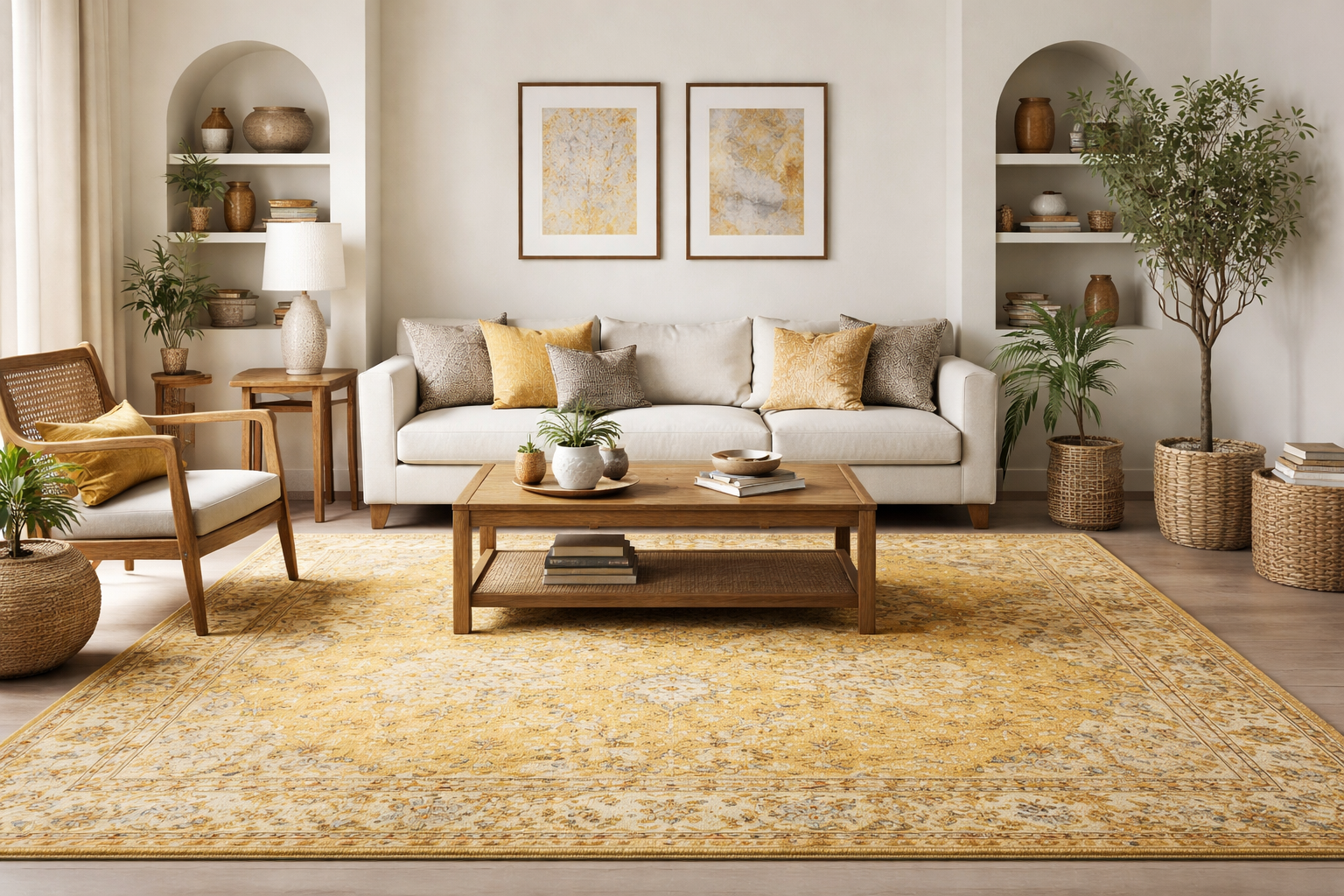
Yellow has a unique relationship with light. Among all interior colors, it reflects light more efficiently, which means it can change how a room feels almost instantly. Even when the shade is muted or earthy, yellow increases perceived brightness rather than actual brightness. This is why rooms with modern yellow rugs elements often feel warmer and more alive, even without additional lighting.
When yellow is used in a rug, its effect is more controlled. Because the color sits at floor level, it spreads warmth upward without overwhelming the eye. This makes yellow especially useful in rooms that feel visually flat or emotionally cold.

When designers reach for yellow
Designers rarely use yellow randomly. It is chosen with specific problems in mind.
Yellow is often introduced when a room lacks natural sunlight and feels dull during the day. In such spaces, yellow compensates for missing warmth and helps balance cooler light conditions.
It is also used when a room’s palette becomes overly grey or neutral. Too many cool neutrals can make a space feel lifeless, even if it looks stylish. Yellow brings subtle energy back without disrupting harmony.
Another reason yellow is chosen is when a space needs energy but cannot afford visual clutter. Instead of adding more furniture, patterns, or decor, a single warm color can lift the entire mood of the room.
The common mistake with yellow
The biggest mistake people make is choosing yellow that is too bright or too saturated. Strong yellow spreads visual energy very quickly. In rooms that already contain patterns, textures, or bold furniture, this creates restlessness rather than comfort.
Because yellow rugs naturally attracts attention, it becomes overpowering when combined with busy surroundings. The eye has no place to rest, which makes the room feel tense instead of welcoming.
This is why many people feel unsure about yellow after a bad experience. The issue is rarely the color itself, but the intensity and context in which it is used.
How muted yellow works best
Muted yellow behaves differently. When softened, it warms the room without demanding focus. It works as a supporting color rather than a statement.
Muted yellow performs best when walls are neutral and allow the rug to introduce warmth gently. Simple furniture shapes help the color feel intentional rather than decorative. Minimal patterns keep the visual field calm so yellow can do its job quietly.
In these conditions, yellow becomes an accent foundation. It supports the room’s mood, adds comfort, and improves brightness without becoming the main attraction.
Understanding yellow’s role in balance
Yellow is most effective when it is treated as a background enhancer rather than a dominant force. Its role is to improve how the room feels, not to define how it looks.
When used with restraint, yellow brings warmth, clarity, and energy in a way that feels natural over time. When overused, it becomes tiring. Knowing this balance is the key to using yellow successfully in interior spaces.
Brown rugs: depth, weight, and visual grounding
Brown is often chosen for practical reasons, but its role in interior design is far more structural than decorative. Many people underestimate brown because it feels familiar, but that familiarity is exactly what gives it power. Brown rarely asks for attention. Instead, it quietly shapes how grounded or unstable a room feels.
In well-designed interiors, brown is used to create visual weight at the lowest level of the space. This weight is what makes furniture feel settled rather than temporary.

Why brown grounds a space
Brown is closely associated with natural materials such as soil, wood, leather, and stone. Because of this association, the eye reads brown as something solid and dependable. When brown is used in a rug, it visually anchors everything placed on top of it.
Furniture placed on a brown rug feels intentional rather than accidental. Chairs stop looking like they are floating. Sofas feel connected to the room instead of sitting on top of it. This grounding effect is especially noticeable in open layouts where there are no walls to define zones.
Designers often rely on brown when a room feels visually unstable or disconnected. Instead of adding more furniture or decor, they introduce weight at floor level to restore balance.
How brown controls visual weight
Every room has a visual center of gravity. When that center is too high, the space feels top-heavy. When it is too low, the room can feel dull. Brown helps control this balance by pulling visual attention downward in a calm, controlled way.
Unlike black, which can feel sharp or dramatic, brown absorbs attention softly. It holds space without dominating it. This makes it ideal for everyday environments where comfort matters more than impact.
Light brown vs dark brown: a critical distinction
Not all brown behaves the same way. The difference between light and dark brown is significant and often misunderstood.
Light brown tones blend easily with beige, cream, and natural wood finishes. They feel relaxed and organic rather than formal. These shades work especially well in family spaces where comfort and ease are priorities. Because light brown reflects more light than darker tones, it maintains openness while still providing grounding.
Light brown rugs support interiors that rely on natural materials and soft palettes. They allow rooms to feel warm without becoming visually heavy.
Dark brown, on the other hand, introduces seriousness and structure. It adds visual weight quickly and is often used to define areas within larger rooms. In spacious living rooms or open-plan layouts, dark brown helps separate seating zones without physical barriers.
However, dark brown requires balance. Without enough light or contrast, it can overpower a room. Designers often pair it with lighter walls, upholstery, or surrounding elements to prevent compression.
How brown interacts with furniture and materials
Brown rugs respond strongly to the materials around them. When paired with wood, they reinforce warmth and continuity. When combined with leather, they increase the sense of richness and durability. With lighter fabrics, brown creates contrast that makes furniture shapes clearer.
In modern interiors with clean lines, brown softens sharp geometry. In traditional spaces, it enhances depth and stability. This adaptability is one reason brown remains relevant across styles.
Where brown does not work well
Despite its strengths, brown is not suitable everywhere. In small rooms with limited natural light, dark brown rugs can absorb too much brightness. When combined with dark furniture and walls, the space can feel compressed and heavy.
Designers avoid stacking heavy tones together. Too much visual weight at the same level makes a room feel closed rather than grounded. In such cases, lighter rug tones or increased contrast are preferred.
Brown also loses its effectiveness in overly decorative spaces. When surrounded by too many patterns or strong colors, its grounding role becomes unclear.
Understanding brown’s true purpose
Brown is not meant to decorate a room. It is meant to support it.
Its value lies in how it stabilizes space, connects furniture, and creates a sense of permanence. When used correctly, brown fades into the background while quietly holding everything together. This is why it remains one of the most trusted colors in interior design, even when trends change.
Ivory rugs: why designers use them so often
Ivory rugs are not chosen because they are neutral or safe. They are chosen because they quietly solve multiple spatial problems at once. In interior design, ivory is a working color rather than a decorative one. It rarely draws attention to itself, but it significantly changes how a room is perceived.
Designers often reach for ivory when a space feels visually crowded, heavy, or closed. Instead of removing furniture or repainting walls, they use ivory at floor level to reset the visual balance of the room.

What ivory actually does inside a space
Ivory reflects light softly rather than sharply. Unlike pure white, it does not create glare or harsh contrast. This softer reflection spreads light evenly across the room, making the space feel calmer and more controlled, which is especially valuable when using ivory tones in bedroom rugs.
Because ivory reduces contrast between the floor, furniture, and walls, it visually expands the room. Edges feel less defined, which tricks the eye into reading the space as larger than it actually is. This effect is subtle but powerful, particularly in bedrooms that feel tight or cluttered, where an ivory bedroom rug helps maintain openness without visual noise.
Ivory also slows the eye. Instead of jumping between strong colors or patterns, the eye moves smoothly across the space. This is why bedrooms with ivory rugs often feel restful even when they contain multiple elements. Used thoughtfully, bedroom rugs in soft ivory tones support relaxation while quietly balancing light, furniture, and architectural lines.
Ivory also slows the eye. Instead of jumping between strong colors or patterns, the eye moves smoothly across the space. This is why rooms with ivory rugs often feel restful even when they contain multiple elements.
Where ivory works best
Ivory performs especially well in small rooms where every visual decision matters. In limited spaces, dark or high-contrast rugs can break up the floor and make the room feel segmented. Ivory keeps the floor visually continuous, which improves flow.
Apartments benefit from ivory for the same reason. Open layouts with mixed functions need a base that does not compete with furniture or decor. Ivory allows different zones to exist without visual conflict.
Minimal interiors rely on ivory to maintain clarity. When furniture lines are clean and decor is limited, ivory supports simplicity without making the space feel empty.
Homes with dark furniture also benefit from ivory rugs. The light floor base creates contrast that highlights furniture shapes while preventing the room from feeling heavy.
Why ivory allows a room to breathe
Ivory creates visual breathing space. It gives objects room to exist without crowding one another. Furniture appears more intentional because it is clearly defined against a calm background.
This breathing effect is one reason designers use ivory in rooms that already contain strong materials like wood, stone, or metal. Ivory balances these textures instead of competing with them.
Where ivory struggles
Ivory is not without limits. In rooms where everything is light and low-contrast, ivory can feel flat or unfinished. Without darker elements, shadows, or texture, the space may lack depth.
Designers prevent this by introducing contrast through furniture, layering fabrics, or adding tactile materials. Even small shifts in tone or texture are enough to give ivory something to work against.
Ivory also requires intentional styling. It works best when the room has a clear structure and purpose. In cluttered or poorly planned spaces, ivory cannot correct deeper design issues.
Understanding ivory’s true role
Ivory is not meant to make a statement. It is meant to support everything else in the room.
Its strength lies in restraint. When used thoughtfully, it brings clarity, calm, and openness without calling attention to itself. This is why ivory remains a favorite among designers, not for how it looks alone, but for how it makes a space feel.
Multi-color rugs: controlled complexity, not chaos
Multi-color rugs tend to divide people. Some are drawn to them instantly, while others avoid them completely. This reaction usually has less to do with taste and more to do with past experiences. When a multi-color rug fails, it feels chaotic. When it works, it feels expressive and intentional.
The difference is control.
Designers never treat multi-color rugs as casual choices. They are approached as complex visual tools that require planning, not impulse.
Understanding the dominance rule
Every multi-color rug has a hierarchy, even if it is not obvious at first glance. One color always leads visually, while the others support it. This leading color sets the tone of the rug and determines whether it will integrate into the room or fight against it.
If the dominant color in the rug has no relationship to the room, the rug feels random. The eye cannot find a connection point, so the space feels unsettled. When that dominant color is echoed somewhere else, even subtly, the rug immediately feels intentional.
This echo does not need to be literal or large. It can appear in a cushion, a piece of artwork, or a small object. The goal is connection, not repetition.
Why multi-color rugs work in specific environments
Multi-color rugs perform best in neutral rooms that lack personality. In these spaces, the rug becomes the main source of visual interest, adding movement without requiring multiple decorative elements. This is why many homeowners naturally gravitate toward mid-sized formats like 6x9 rugs. They feel substantial enough to carry color and pattern, yet restrained enough to avoid overwhelming the room.
They are also effective in open-plan layouts. In homes where walls no longer clearly separate functions, a multi-color rug often becomes the visual cue that defines space. A 6x9 rug frequently sits at the center of this decision because it comfortably fits common seating arrangements, helping distinguish a living area or reading corner without breaking the openness of the layout.
Creative households often choose multi-color rugs because they allow expression without rigid structure. A size like 6x9 works well in these environments because it anchors furniture while leaving breathing room around it. The rug feels intentional rather than dominant, supporting individuality while still keeping the space visually grounded.
Creative households often gravitate toward Handmade rug because they allow expression without rigid structure. When used thoughtfully, 6x9 rugs support individuality while still anchoring furniture groupings and maintaining balance within the overall layout.
When multi-color rugs fail
Struggle in rooms where everything is already competing for attention. Patterned sofas, bold wall colors, textured finishes, and decorative accessories can overwhelm the visual field when combined with a complex rug.
In these cases, the rug does not ground the space. Instead, it adds another layer of noise. The eye moves constantly without resting, which creates discomfort rather than energy.
Designers avoid placing the rug in spaces where visual hierarchy is already weak. If the room does not have a clear structure, a complex rug will only amplify the problem.
How restraint makes multi-color rugs successful
Restraint elsewhere is what allows complexity to work. When furniture shapes are simple, walls are calm, and materials are limited, a multi-color rug can exist comfortably without overpowering the room.
This balance is why designers often simplify everything around a multi-color rug. The rug carries the expression so the rest of the room does not have to.
The real role of multi-color rugs
Multi-color rugs are not meant to fix poorly designed rooms. They are meant to enhance well-considered spaces.
When used with awareness, they bring depth, movement, and personality without chaos. When used without restraint, they create confusion. Understanding this difference is what separates intentional design from visual clutter.
Using color to fix common room problems (deep practical section)
Room feels cold
Use warmer rug tones. Even neutral warmth changes perception.
Room feels small
Lighter rugs with low contrast edges expand space.
Room feels chaotic
Reduce rug contrast and simplify palette.
Furniture feels disconnected
Choose a rug color that bridges tones rather than matches one item exactly.
This is how designers use rugs as problem-solvers.
Shape and proportion: how color behaves differently
Color strength changes with shape.
Organic shapes soften strong colors. That’s why unshaped rugs make bold tones feel more natural.
Rectangular rugs emphasize structure. The larger the rug, the more evenly color spreads. Formats like 8x10 rugs help color act as a foundation instead of a focal point.
Small rugs intensify color. Large rugs distribute it.
Why restraint always beats trends
Every room carries its own personality. Some spaces feel bold and structured, while others rely on calm, restraint, and simplicity. In interiors that lean toward minimalism, atmosphere becomes more important than decoration. This is where a minimal rug plays a critical role. It is not meant to attract attention or dominate the room. Instead, it supports the space quietly, allowing light, furniture, and architecture to do their work without visual interruption.
A minimal rug works by reducing visual noise. It creates a clean foundation that helps the eye settle, especially in rooms with simple layouts and limited décor. Rather than competing with furniture or wall colors, it brings everything together subtly. This is why designers often compare rugs to emotional lighting. You may not notice them immediately, but you feel their impact the moment they are missing.
In practical terms, a minimal rug helps define space without over-defining it. It softens hard floors, balances sharp edges, and makes a room feel intentional instead of empty. In modern homes, where clean lines and open layouts are common, a minimal rug ensures the space feels warm and livable rather than cold or unfinished.
The strength of a minimal rug lies in restraint. By doing less visually, it allows the room to do more emotionally. This is not about trends or preference. It is about creating balance, calm, and long-term comfort in a way that feels natural every single day.
Final perspective
Choosing a rug by color is not about what looks good today. It’s about how a space feels every day.
When color, light, size, and function align, the room feels effortless. And that effortlessness is the real goal of good design.
FAQs
1. How do I know if a rug color will feel good over time?
Colors that overstimulate the eye tend to feel tiring with daily exposure. Neutral and balanced tones usually perform better in rooms where people spend long hours. Testing how a color looks in both daylight and evening light helps predict long-term comfort.
2. Should a rug match the sofa or contrast with it?
Exact matching often makes a room feel flat. A better approach is to create a relationship between tones, where the rug either supports or gently contrasts the furniture. This adds depth without visual tension.
3. Can a rug color change how big or small a room feels?
Yes. Lighter rug colors tend to expand visual space by reflecting light, while darker colors add weight and grounding. The effect becomes stronger depending on room size and available natural light.
4. Why do some rugs look good in photos but not in real rooms?
Images often hide how light, flooring, and surrounding materials affect color. In real spaces, color interacts with shadows and textures, which can change its appearance. This is why considering the room environment is more reliable than relying on images alone.
About the author
Afzal Rub is an interior designer who graduated from Pearl Academy of Design with a degree in Textile Interior Design in 2016. He then began his career in New Delhi City by spearheading his own design firm decordec, which handles various high-end design projects in India and beyond. His work has been featured in celebrity homes and he is known for his characteristic of being a tastemaker in the carpet world.
In 2019, Afzal opened his own Decordec, a creative ecosystem for collaboration and development, focusing on experimentation, craftsmanship and technique. Here, artists come together to narrate tales of evolving aesthetics. Decordec is particularly known for its geometry, materiality, and simple aesthetic.
Furthermore, amid a global pandemic that has brought the entire world to a standstill, Afzal wanted to create a formalised body of change amongst designers and has been able to conceptualise and collaborate to launch.
In 2019, Afzal opened his own Decordec, a creative ecosystem for collaboration and development, focusing on experimentation, craftsmanship and technique. Here, artists come together to narrate tales of evolving aesthetics. Decordec is particularly known for its geometry, materiality, and simple aesthetic.
Furthermore, amid a global pandemic that has brought the entire world to a standstill, Afzal wanted to create a formalised body of change amongst designers and has been able to conceptualise and collaborate to launch.
written by Talha Ansari